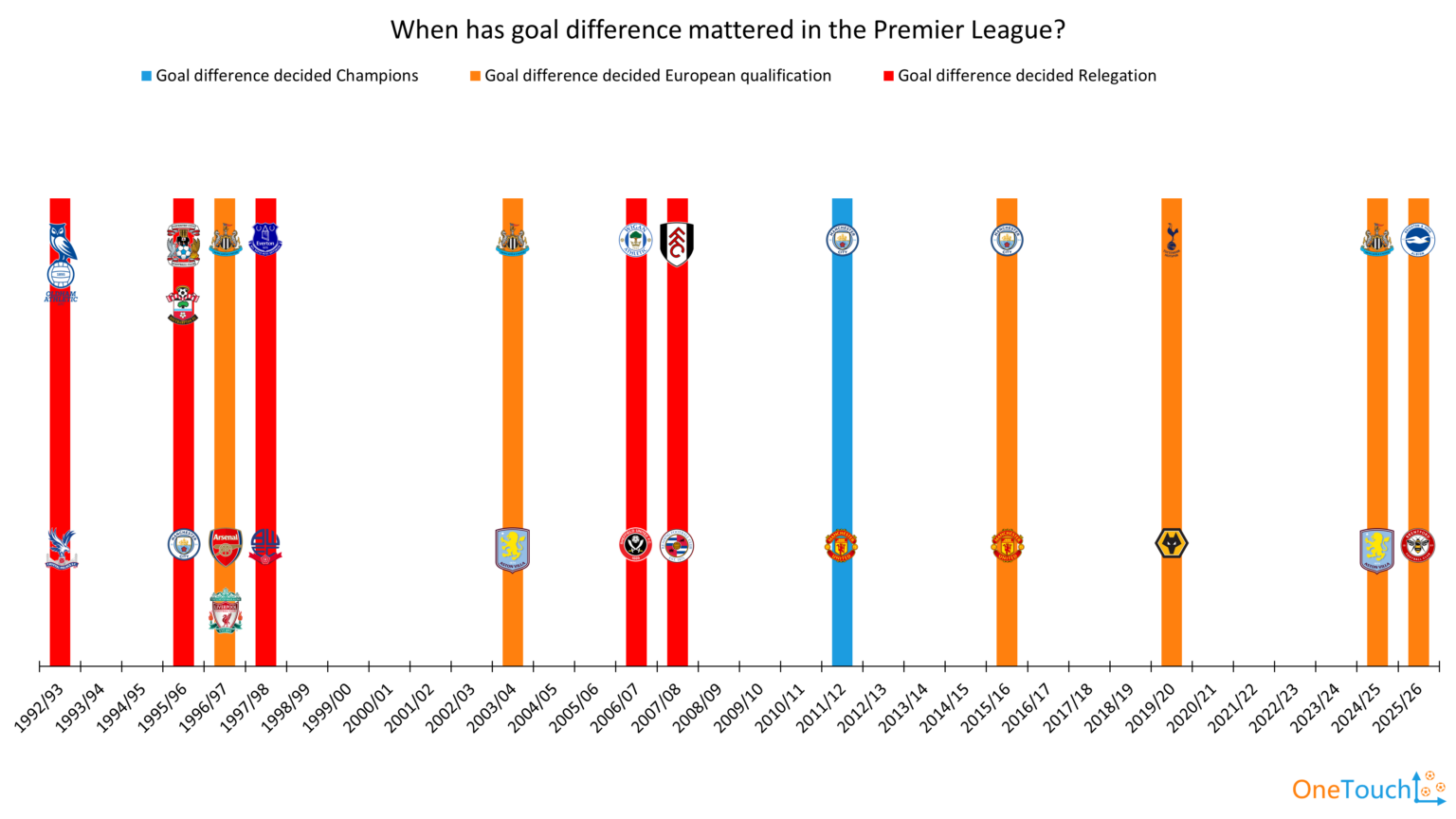
The 2025/26 Premier League season has just reached its conclusion, and Brighton & Hove Albion have just confirmed their place in the Europa Conference League for the 2026/27 season, despite being comfortably beaten 3-0 by Manchester United on the final day. Their qualification came down to them having a superior goal difference (GD) over Brentford, who could only manage a 1-1 draw at Anfield in their final game. Brentford thus miss out on European football, meaning that GD has played a significant part in their season, but how often does this actually happen?
It’s often said that having a greater GD than a direct rival is like having an extra point, but how often has that ‘extra point’ been meaningful in the Premier League (PL)? The most famous example of GD being meaningful came in the 2011/12 season, when Manchester City bested their city rivals Manchester United to win their first ever PL title.
However, this is the only occasion in PL history where the title was decided on goal difference, so how often does it actually matter for a team to rack up the goal difference during a season? And for the occasions that it was significant, how important were the head-to-head match-ups?
If you’re new to football:
What is goal difference? – A team’s goal difference is the number of goals they scored throughout a season minus the number of goals they conceded. E.g. If a team scored 65 goals during a season and conceded 43, their goal difference = 65 – 43 = 22. The higher the number the better. Goal difference is used as the first tiebreaker in the PL when teams have the same number of points, you can see all the tiebreakers here.
How often is goal difference significant?
There have now been 34 full seasons of the PL spanning from 1992 to 2026. During these 34 seasons, multiple teams have finished on the same number of points 92 times.
However, examples like Manchester United pipping Wolves to 15th on goal difference in 2024/25 don’t really mean anything (apart from some extra prize money).
The only times where goal difference actually matters falls into 3 different categories:
Of the 92 times multiple teams finished on equal points, only 12 of them fall under one of these three categories, including Brighton’s qualification over Brentford today.
Occasions where goal difference had a significant impact at the end of each PL season.
It should be noted that this simple analysis ignores the occasions where teams are not directly affected by goal difference at the end of the season. For example, at the end of the 2013/14 season, with Manchester City and Liverpool battling for the title, Liverpool attempted to catch-up to City’s superior goal difference in their penultimate game against Crystal Palace. They went 3-0 up and started to chase more goals, but Crystal Palace pulled the game back to 3-3 in dramatic fashion. Because of these 2 dropped points, Liverpool finished 2 points behind City, but it could be argued that they would have lost the league on GD if they had stopped pushing for goals against Palace. These types of events are very difficult to define, so they are not included.
So, on average, goal difference only plays a significant role roughly once every three seasons in the PL. Let’s have a look at how the final day of the league played out on these 11 other occasions and see how differently they could’ve finished if the head-to-head matches ended differently.
1. Winning the league (1 occurrence)
2011/12 Manchester City win the PL on goal difference over their neighbours Manchester United.
As mentioned above, the only time in PL history where the league was decided on goal difference came in the 2011/12 season, with Manchester City and Manchester United both finishing on 89 points, but with City scoring 4 more goals and conceding 4 less than their local rivals. The two teams went into the final day level on 86 points, with City playing their final match at home to relegation-threatened Queens Park Rangers, and United away at mid-table Sunderland.
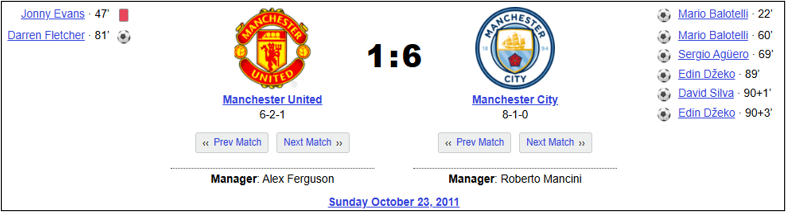
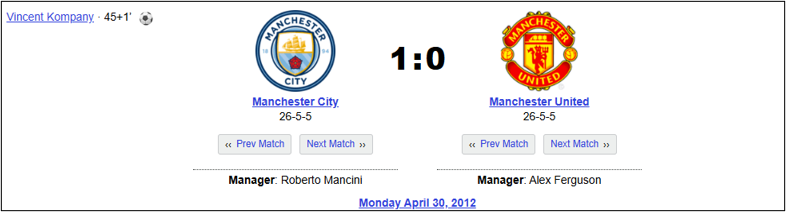
When looking at the head-to-head results between the two teams that season, it does not paint a pretty picture for Manchester United…
Head-to-head results between Manchester City and Manchester United during the 2011/12 season.
Interestingly, if the first fixture between the two ended 2-1 to City rather than 6-1, then the two teams would’ve finished on equal points, goal difference, and goals scored, although City would still have won the league via the head-to-head tiebreaker.
As heartbreaking as this season was for Manchester United fans, Alex Ferguson went on to sign the league’s best striker in Robin Van Persie from Arsenal during the summer and stormed to the league title the following season in 2012/13.
This is by far the most significant occasion where goal difference mattered, but what about the other times when it had an impact?
2. Qualifying for a European competition (or a better European competition) (5 occurrences)
1996/97 Newcastle United beat out both Arsenal and Liverpool on goal difference to secure qualification to the Champions League.
During the 1996/97 season, only the top two teams qualified for the Champions League and with Manchester United having secured the title, the last Champions League qualification spot came down to the final match.
Liverpool on 67 points (GD = 25), Newcastle & Arsenal both on 65 (both with a GD of 28).
Liverpool played away to 7th place Sheffield Wednesday, Newcastle at home against bottom-of-the-table Nottingham Forest, and Arsenal travelled to mid-table Derby County. As you can tell from the above table, Liverpool did not win their final game to secure second place, instead achieving a 1-1 draw while Newcastle demolished Forest 5-0 and 10-man Arsenal came from 1-0 down to secure a late 3-1 victory. Both Newcastle and Arsenal thus leapfrogged Liverpool, with Newcastle securing qualification to the Champions League for the 1997/98 season.
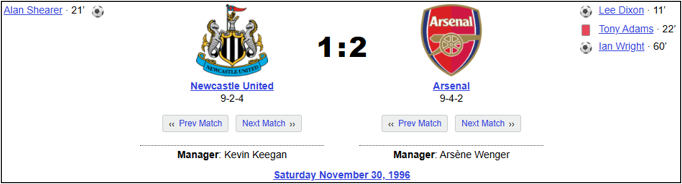
Looking at the head-to-head match-ups between the 3 teams, there’s not much more Liverpool could have done against their closest rivals.
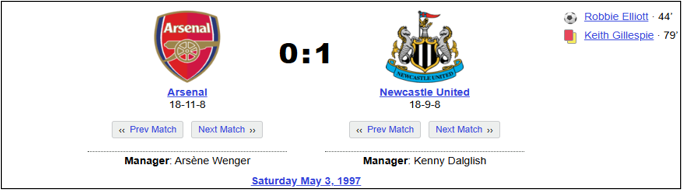
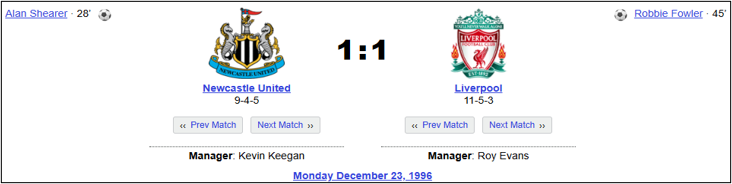
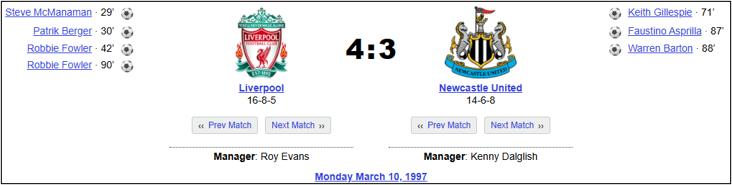
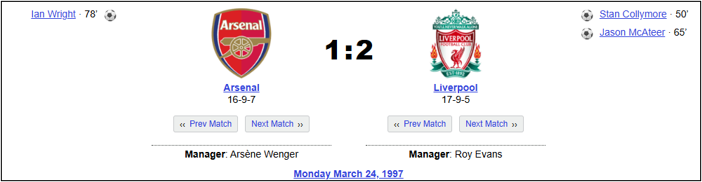
Head-to-head results between Newcastle United, Arsenal, and Liverpool during the 1996/97 season.
With Liverpool doing the double over Arsenal and getting 4 points from Newcastle, they had firmly put themselves in the driver’s seat over their closest rivals. Newcastle and Arsenal traded away victories in their head-to-heads, and Arsenal would go on to rue not getting a single point against Liverpool.
All 3 teams went on to have quite disastrous European campaigns in 1997/98, with Newcastle getting knocked out in the group stage, finishing behind Dynamo Kyiv and PSV (but ahead of Barcelona!). Arsenal crashed out in the first round of the UEFA Cup against PAOK, and Liverpool did only slightly better, reaching the second round before losing to Strasbourg.
2003/04 Newcastle United qualify for the UEFA Cup over Aston Villa on goal difference.
Heading into the last day of the 2003/04 season, the top 4 places were all sewn up, with Arsenal, Chelsea, Manchester United, and Liverpool qualifying for the Champions League. That left the last European spot to be fought between Newcastle and Aston Villa.
Going into the final matchweek, Aston Villa stood on 56 points with a GD of 6, closely followed by Newcastle, on 55 points with a GD of 12.
Villa needed a win to fully assure themselves of qualification, but had a tricky final match against 3rd-placed Manchester United, which eventually ended in a 2-0 defeat, after they conceded twice in the opening 10 minutes. Villa thus needed to rely on 4th place Liverpool to do them a favour and beat Newcastle at Anfield, but unfortunately for them, the game ended in a 1-1 stalemate.
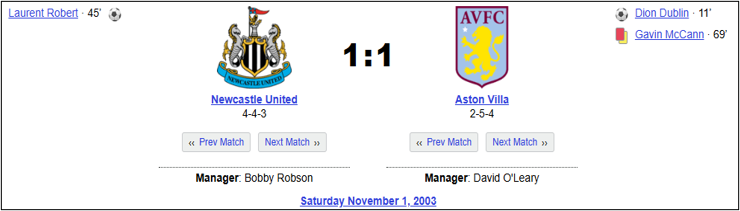
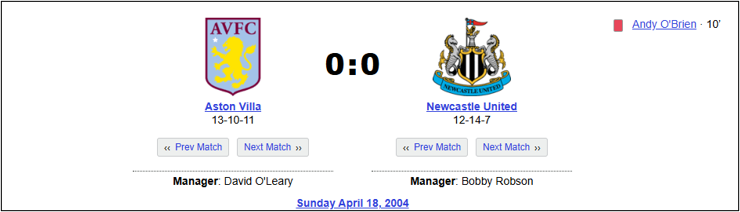
Looking at the head-to-heads between the two, there was not much to split them.
Head-to-head results between Newcastle United and Aston Villa during the 2003/04 season.
Aston Villa were probably kicking themselves that they didn’t go on to win the second head-to-head, with Newcastle going down to 10 men after 10 minutes. This eventually cost them their spot in the UEFA Cup. Newcastle went on to enjoy a pretty decent showing in the 2004/05 UEFA Cup, getting to the quarter-finals before losing to Sporting CP.
2015/16 Manchester City qualify for the Champions League over their city rivals Manchester United on goal difference.
At the end of the 2015/16 season, Manchester City continued to be a pain in the arse to their local rivals. Just 4 years after City won the league on goal difference over United, they were qualifying for the Champions League, again on goal difference, ahead of them.
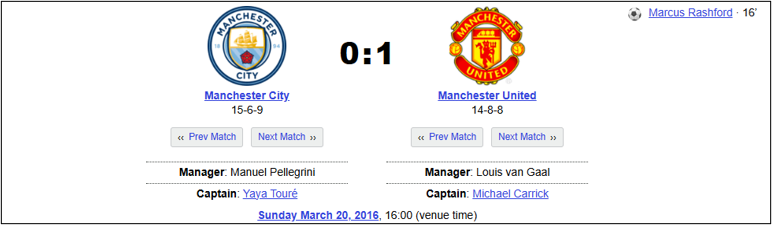
Looking briefly at the head-to-heads, United did about as much as they possibly could have.
Head-to-head results between Manchester City and Manchester United during the 2015/16 season.
If United had managed to do the double over City, then they would have qualified for the Champions League. However, achieving 4 points out of 6 against your closest rivals is not a bad return, and I’m sure United fans had other games they regretted dropping points in more throughout the season.
While the end of this season must have hurt for United fans, it turned out to be a blessing in disguise in Europe. With them dropping down to the Europa League instead of the Champions League in 2016/17, they went on to win the trophy, beating Ajax 2-0 in the final. City, on the other hand, enjoyed a decent run-out in the Champions League, finishing second behind Barcelona in their group before going out in the round of 16 to Monaco in a bonkers tie that finished 6-6 over the two legs.
2019/20 Tottenham Hotspur qualify for the Europa League over Wolverhampton Wanderers on goal difference.
Another Europa League qualification decided on goal difference, this time with Spurs being the beneficiary ahead of Wolves. The two went into the final game of the season with Wolves ahead on 59 points with a GD of 13 and Spurs right behind on 58 points and a GD of 14.
Wolves had a difficult final fixture, playing away to fourth-place Chelsea, while Spurs travelled to 14th-placed Crystal Palace. Spurs finished their match with a 1-1 draw thanks to an early Harry Kane opener, meaning that if Wolves matched their result, they’d be playing European football the following season. Unfortunately for them, they went behind 2-0 to Chelsea, with both goals coming in first-half stoppage time. The game ended with this scoreline, meaning Spurs would be playing in the Europa League.
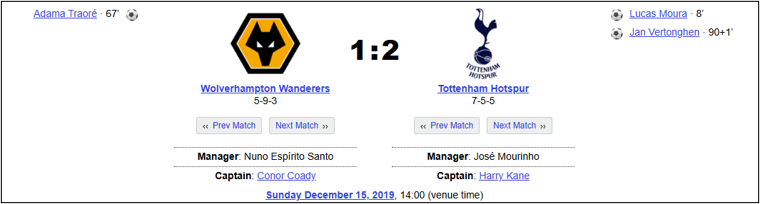
The two teams were obviously very evenly matched throughout the season, and this showed in their head-to-head results.
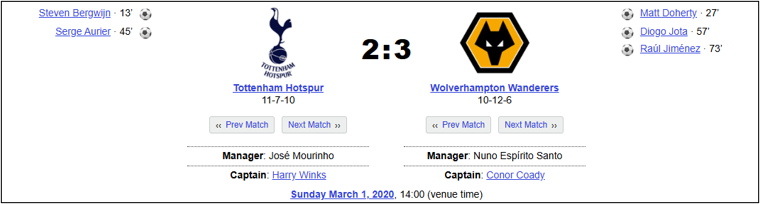
Head-to-head results between Tottenham Hotspur and Wolverhampton Wanderers during the 2019/20 season.
Both teams won at each other’s home grounds, splitting the points evenly. Wolves would come to feel the effects of that late Jan Vertonghen winner, as a point in that game would’ve had a 3-point swing in their favour, which would have qualified them for the Europa League.
2024/25 Newcastle United qualify for the Champions League over Aston Villa on goal difference.
We saw previously, that in the 2003/04 season, Newcastle qualified for the UEFA Cup at the expense of Aston Villa on goal difference, and they repeated the trick to qualify for the Champions League ahead of them last season.
To set the scene for the final day, both Newcastle and Villa entered the day level on points on 66 points (along with Chelsea!), Newcastle having a goal difference of 22, Chelsea on 20 and Aston Villa on 9. Newcastle had a home game against 13th-placed Everton, while Chelsea travelled to 7th-placed Nottingham Forest (who also could’ve qualified for the Champions League with a win!) and Aston Villa travelled to a Manchester United side which finished 15th.
Chelsea won a tight game 1-0 against Forest, leaving the final Champions League spot to be filled by either Newcastle or Aston Villa. Just before Chelsea scored their winner, Aston Villa were reduced to 10-men at Old Trafford with Emi Martinez receiving a straight red card.
Newcastle then went a goal down at home to Everton, giving Villa fans cause for optimism. If Villa could hold out and scrape a draw, it might’ve been enough. Villa then had a goal controversially disallowed, when Morgan Rogers was adjudged to have kicked the ball out the Manchester United goalkeeper’s hands. Villa went on to lose the game 2-0, thankfully for Newcastle fans, as they saw their team lose 1-0. Newcastle thus qualified for the Champions League due to their superior goal difference.
Looking at the head-to-heads between the two teams, there is some nice symmetry between the two results.
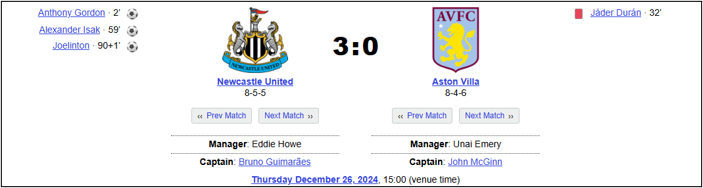
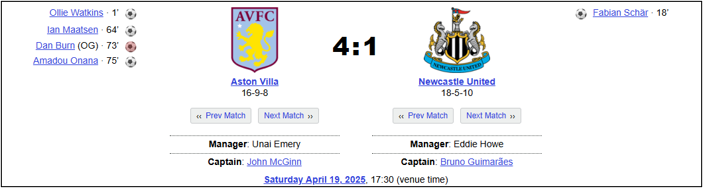
Head-to-head results between Newcastle United and Aston Villa during the 2024/25 season.
Both teams won their home fixtures by 3 clear goals, which left them both with 3 points and 0 GD. Interestingly, in the highly unlikely situation that the two had finished on the same points, goal difference, and goals scored, Newcastle would still have qualified due to the one away goal they scored in the head-to-head match-up.
Despite the heartbreak of not qualifying for the CL on the last day of the season, Villa ended up winning the Europa League, beating Freiburg 3-0 in the final. Unai Emery once again showing that he is the king of the Europa League.
1992/93 Crystal Palace are relegated from the Premier League due to their inferior goal difference to Oldham Athletic.
The inaugural season to the Premier League saw the relegation battle come down to the last matchweek, which was then decided on goal difference.
The table looked good before the final day for Palace, with them having a three-point lead over Oldham. Palace stood on 49 points with a GD of -10 and Oldham on 46 points with a GD of -12. The task was very simple for Oldham, they needed to win at home to fellow strugglers Southampton on the last day, and hope that mid-table Arsenal could do them a favour by beating Palace at Highbury. Due to Oldham’s vastly superior number of goals scored, they knew that pretty much any set of a win for them and a loss for Palace would save them from the drop.
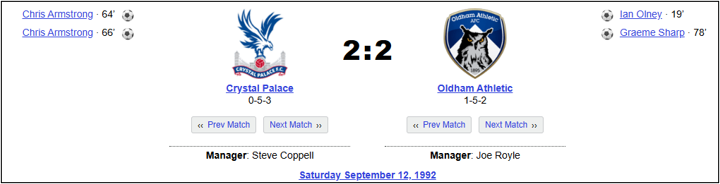
Looking at the head-to-heads, neither team got an edge over the other.
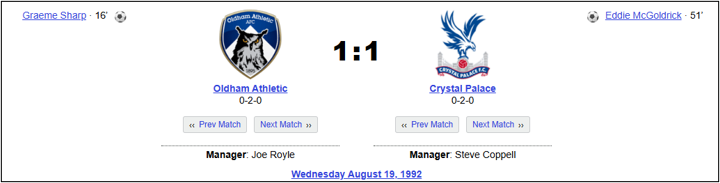
Head-to-head results between Oldham Athletic and Crystal Palace during the 1992/93 season.
Interestingly, the two head-to-heads between these teams were both played near the start of the season, one in August and one in September. It seems a strange concept nowadays to not play against a fellow relegation-struggler for a full 8 months from September to May. Perhaps Palace would have thrown extra men forward to try get a winner in the home fixture if the match was played later in the season?
Oldham fans’ joy from the final day didn’t last too long however, as they were relegated the following season, and, as of the time of writing, have never returned to the top division. Crystal Palace, on the other hand, came straight back up to the PL, winning the First Division at the first time of asking.
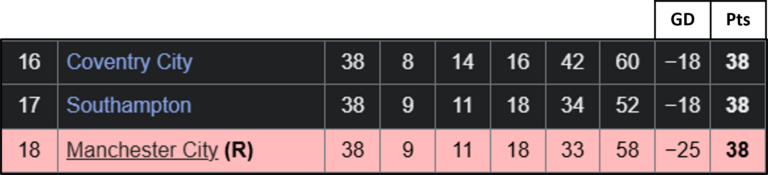
1995/96 Manchester City are relegated from the Premier League due to their inferior goal difference to Coventry City and Southampton.
The only other occasion of a three-way significant tie on goal difference came in the 1995/96 season. Coventry, Southampton, and Manchester City all went into the final day on 37 points, with Coventry and Southampton having a 7 goal advantage on GD over Man City.
Man City went into the final day, a home game against 3rd-place Liverpool, knowing that they pretty much needed a win to stand a chance at staying up. Both Coventry and Southampton faced home games against teams just above them in the table, playing Leeds United and Wimbledon respectively.
Both Coventry and Southampton played out 0-0 bore draws, meaning that a win would keep City up. However, they went 2-0 down in the first-half to Liverpool, leaving them with not much hope at half-time. They did pull the game back to 2-2 to set-up a nail-biting final 13 minutes, but it was too little too late for them. A winner for them or a winner for Leeds/Wimbledon in the other games would have saved them, but it wasn’t to be.
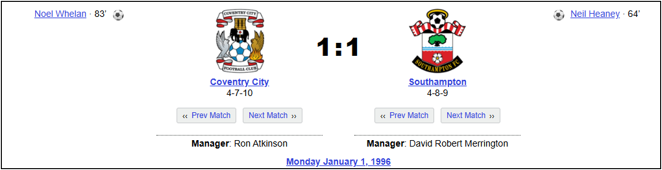
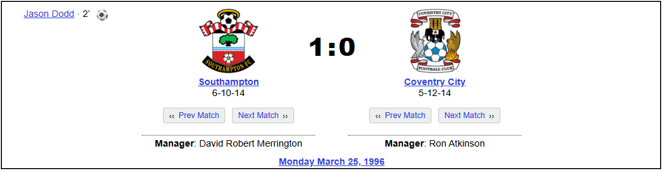
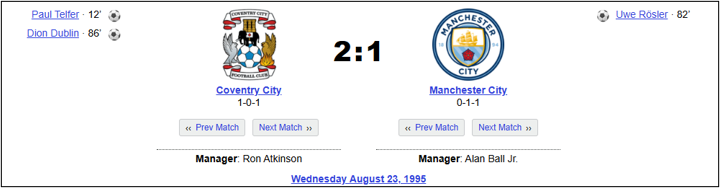
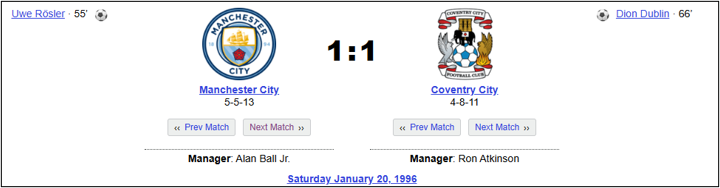
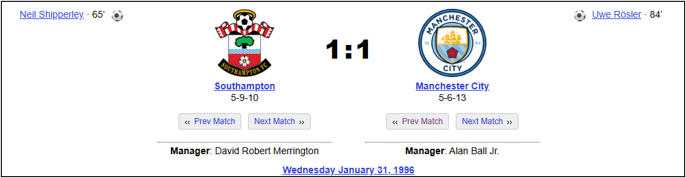
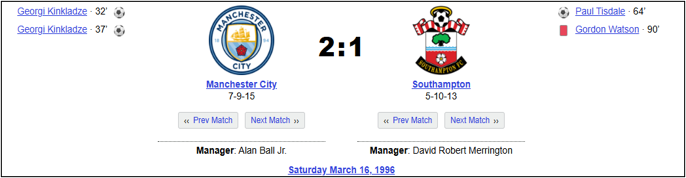
Looking at the head-to-heads between the 3 teams, the one real regret that City would have would be not being able to hold out to win against Coventry in January.
Head-to-head results between Coventry City, Southampton, and Manchester City during the 1995/96 season.
Gaining 4 points against Southampton was a good showing by City, but only gaining a solitary point against Coventry eventually cost them. City did not enjoy their time in the lower division, and actually found themselves relegated to the third tier 2 years after leaving the PL. They did eventually reestablish themselves as a top-flight team again before becoming the juggernaut you see today, thanks to their totally legitimate revenue stream.
1997/98 Bolton Wanderers are relegated from the Premier League due to their inferior goal difference to Everton.
There was one more occasion in the 90’s where goal difference was significant and that came in the 1997/98 season between Bolton Wanderers and Everton.
Bolton went into the final day on 40 points with a GD of -18 and Everton on 39 points with a GD of -15. Bolton, however, faced a tough away day against 4th-placed Chelsea, while Everton faced mid-table Coventry City at home. Bolton almost took the lead early at Stamford Bridge with Per Frandsen almost scoring the goal of the season before seeing his effort cleared off the line (0:23 timestamp). By this time though, Everton had taken an early lead against Coventry, so a draw would do nothing for Bolton anyway. Bolton went on to lose 2-0 to Chelsea, so although Everton were pegged back late to 1-1 by Coventry, the draw was enough thanks to their superior goal difference.
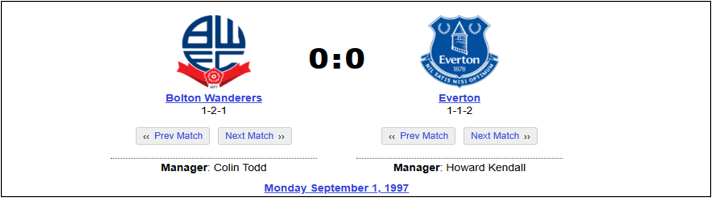
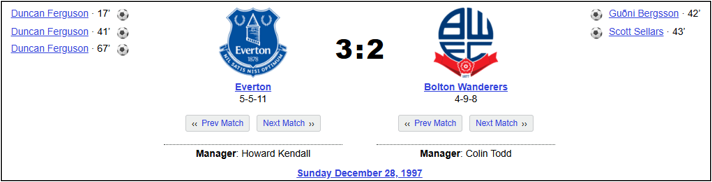
Taking a peek at the teams’ head-to-heads, Bolton’s loss at Goodison Park proved to be fatal.
Head-to-head results between Everton and Bolton Wanderers during the 1997/98 season.
Duncan Ferguson scoring a hattrick against Bolton in December proved to be a crucial moment in the relegation battle. Bolton spent the next 3 seasons in the old First Division before bouncing back up to the Premier League where they became a mainstay for over 10 years. Everton have still never been relegated from the top divison since it’s rebranding in 1992/93, but they haven’t quite experienced being so close to relegation than the 1997/98 season.
2006/07 Sheffield United are relegated from the Premier League due to their inferior goal difference to Wigan Athletic.
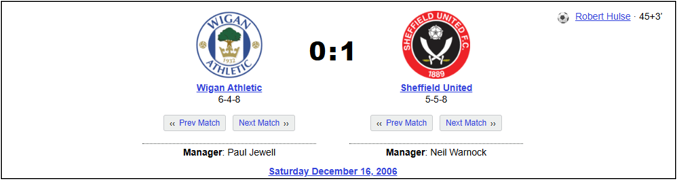
The penultimate occasion where goal difference decided the relegation battle was perhaps the most dramatic end to a relegation battle in Premier League history. The reason for this is that the two teams who were battling for the last place to remain in the league played each other in the final matchweek.
Before kickoff for the final matchweek, Sheffield United stood 3 points clear of Wigan with a goal difference 1 better than them. West Ham United also stood on 38 points, but managed to win 1-0 at the home of the champions Manchester United on the final day, securing their place in the following season’s PL. The situation was very clear for Wigan- they needed to win to stay up, no other result would do it.
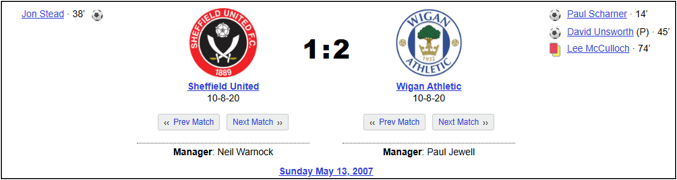
The first-half of the match was filled with drama, with Wigan striking first early on, then Sheffield United equalised, before a late penalty to Wigan put them ahead at the break. About 10 minutes into the second-half, United’s Danny Webber missed a glorious chance to equalise, hitting the inside of the post when 1-on-1 with the goalkeeper. This miss proved to be decisive, as despite going down to 10-men, Wigan managed to hold out for the win that ensured their Premier League survival.
The season was mared with controversy, however, as West Ham were hit with a £5.5 million fine for the signings of Javier Mascherano and Carlos Tevez (it was Tevez who scored the final day winner against Manchester United). Had this fine been a points deduction, it would have seen West Ham relegated instead of Sheffield United. Sheffield United were awarded £20 million two years later after they took West Ham to a tribunal claiming that Tevez’s goals were the deciding point in them being relegated.
Head-to-head results between Wigan Athletic and Sheffield United during the 2006/07 season.
Sheffield United didn’t return to the Premier League again until 2019, as they bounced around between the second and third tiers. Wigan enjoyed a further 6 seasons in the Premier League before they were relegated at the end of the 2012/13 season, and they have since not returned to the top flight.
2007/08 Reading are relegated from the Premier League due to their inferior goal difference to Fulham.
The final example of goal difference having a significant impact came during the 2007/08 season between Fulham and Reading.
The two teams stood on 33 points heading into the final matchweek (with Birmingham City right behind on 32). Fulham, however, had a vastly superior GD -23 to Reading’s -29, so they knew that any sort of win away at 8th-place Portsmouth would surely ensure their survival. It should be noted though that Reading’s final game was at home to Derby County who, to date, are the worst team to have ever played in the PL, so it was not beyond the realms of possibility that Reading could win by 7+ goals.
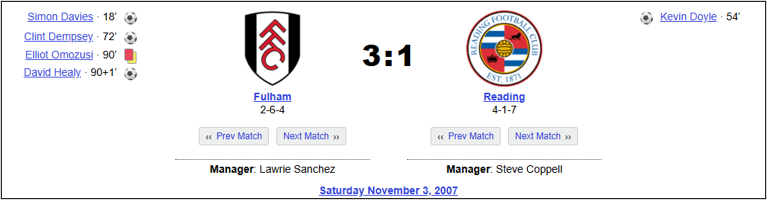
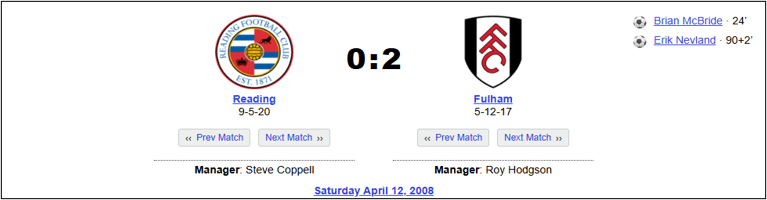
The final day result was the least of Reading’s worries, as if they had achieved even a single point in the head-to-heads with Fulham (or even didn’t concede two 90+ minute goals), they would have survived.
Head-to-head results between Fulham and Reading during the 2007/08 season.
Without the two 90th minute goals, Reading would’ve had a GD of -23 and Fulham -24, meaning that Reading would’ve stayed up. Reading endured 4 seasons in the Championship before getting promoted back to the PL, where they were promptly relegated straight back down and have since not returned to the league. Fulham on the other hand, have been quite a mainstay in the Premier League since 2007/08, but did have a few years where they bounced between the top flight and the second tier.
So, these are the 12 occasions where goal difference had a significant impact on a team’s season, which begs the question, is it worth the energy trying to build up your goal difference in games where you’re winning comfortably? Manchester United fans will probably answer with a resounding yes, after their trauma from the 2011/12 season (and 2015/16), but overall, it doesn’t seem worth the extra effort when it’s quite rare of an occurrence.